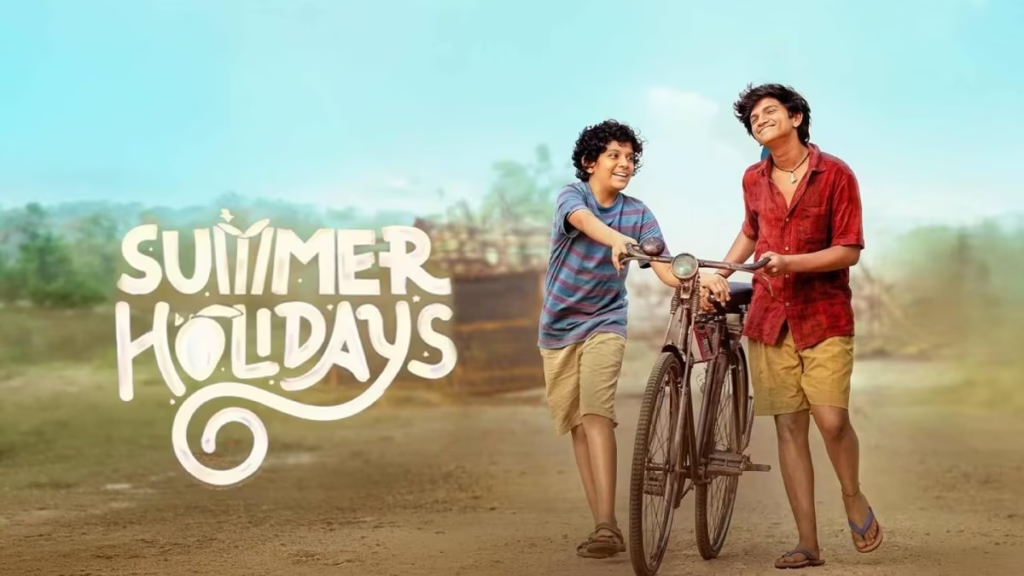
Story
RV (Arun) loves cricket. However, his father (Harshavardhan) keeps pressuring him to study and get a good rank. He promises to buy him a cricket kit if he secures the first rank. Though RV studies well, he manages to get only the tenth rank. As a result, he has to face his father’s anger. Disappointed with this, he visits his grandmother (Jayasudha) in Thotavaripalem for the summer holidays. KV (Roshan) has a different story. He has many struggles in life. His father is no more, and his only wish is to take good care of his mother. He wants to buy her a good saree at least for her birthday. For that, he needs money. He takes a mango orchard on lease to earn it. However, the trees gets no fruits. He tries to somehow make the trees bear mangoes and fulfil his dream. RV, who comes to the village for his holidays, becomes a good friend of KV. How does their journey unfold during the summer holidays? What does RV learn from KV forms the rest of the story of Summer Holidays.
Analysis
The film attempts to bring the lives of children from the 80s and 90s to the screen. Apart from that, the director tries to narrate several other topics. Innocent friendship, the way children think and the pressure parents put on them in the name of education are all woven into the story. The film begins with RV’s story. He is an ordinary child who feels emotionally hurt as his father doesn’t care about his interests. KV enters the story when RV visits his grandmother’s village. While one is an introvert, the other is an extrovert. The first half moves through their friendship, the ups and downs in KV’s life, his struggles and the background of the mango orchard. By the time the interval arrives, we get the feeling that not much has happened in the story. The director spends time introducing the characters and establishing the conflict. However, he does not give the audience enough opportunity to emotionally connect with the main characters on screen. As a result, the film does not create much of an impression after the first half.
The second half brings some movement to the story. The main goal of this film revolves around Roshan’s character. Buying a saree for his mother is a good emotional point, and the director handles it well. This becomes the core point that drives the second half. The scene between Jayasudha and Rajeev Kanakala is also designed well. The idea of completing the task with the courage given by Lord Hanuman is also good. However, the connection between Hanuman and the task is not established strongly. Had the director worked on this aspect, his idea would have been more effective. A dialogue in the climax says, “What can be a bigger coaching centre than a grandmother’s house?” This is absolutely true. However, the director limits this point to just a dialogue. The change in RV is not shown strongly enough. A couple of dialogues are used to convey it.
Harshavardhan getting so emotional and understanding his son also feels like convenient writing rather than something that happens naturally. For the scenes in a film to work, the audience must travel with the characters and feel connected to them. For that to happen, the emotional scenes need to be written strongly. The director struggles in this aspect. The emotions that seem to be present on paper do not translate effectively onto the screen. However, the film does not disappoint completely. A few emotional moments work well and remind children of the 80s and 90s of their own childhood days.
Performances
We have seen Roshan in the web series 90s and he was much younger. He is now grown up, and that maturity is visible in his performance too. He has been flawless in his role. However, the slow-motion frames in a few scenes, designed to present him like a mass hero, feel uncomfortable. Arun does not have this problem. It is difficult for young children to carry such heavy emotions, but both actors handle their roles well. Jayasudha brings her experience to the character. Rajeev Kanakala does the same. Harshini gets a slightly longer role this time and she does justice to it.
Though this is a small film, producer Dheeraj Mogilineni did not compromise on the quality. The camera work is impressive, and the editing is sharp. The film ends within just two hours. The songs are pleasant. The background score tries to enhance the emotions in each scene. A few dialogues stay with us. One line in particular, “When an educated person works, it is called a job; when an uneducated person works, it is called labour,” carries a lot of depth.
Overall, the effort of the director and producer to deliver a feel-good film succeeds to some extent. If the emotions had worked better, Summer Holidays would have been a much better film. If the audience gets reminded of their grandmother’s village and the mischief they enjoyed during childhood, the team of Summer Holidays can consider it a success.
Verdict
Summer Holidays has its moments which takes the audience to the 90s reminding of childhood memories. If the emotions had worked better, Summer Holidays would have been a much better film.